Sunday, March 13, 2011

Google Analysis of Managers

Got sucked in by winter, hopefully I can get back on track with new posts here!

The New York Times this week had a fascinating article on Google using their analysis skills focused on trying to figure out what worked and didn't work for their managers -- and using the feedback to "tune up" their poorer managers.

Many organizations may not have the resources of Google, but this approach is fascinating to me if for no other reason but the intensive and effective focus on what actually works and how do you get there:

“The starting point was that our best managers have teams that perform better, are retained better, are happier — they do everything better,” Mr. Bock says. “So the biggest controllable factor that we could see was the quality of the manager, and how they sort of made things happen. The question we then asked was: What if every manager was that good? And then you start saying: Well, what makes them that good? And how do you do it?”

In Project Oxygen, the statisticians gathered more than 10,000 observations about managers — across more than 100 variables, from various performance reviews, feedback surveys and other reports. Then they spent time coding the comments in order to look for patterns.

Once they had some working theories, they figured out a system for interviewing managers to gather more data, and to look for evidence that supported their notions. The final step was to code and synthesize all those results — more than 400 pages of interview notes — and then they spent much of last year rolling out the results to employees and incorporating them into various training programs.

The process of reading and coding all the information was time-consuming. This was one area where computers couldn’t help, says Michelle Donovan, a manager of people analytics who was involved in the study.

“People say there’s software that can help you do that,” she says. “It’s been our experience that you just have to get in there and read it.”

GIVEN the familiar feel of the list of eight qualities, the project might have seemed like an exercise in reinventing the wheel. But Google generally prefers, for better or worse, to build its own wheels.

“We want to understand what works at Google rather than what worked in any other organization,” says Prasad Setty, Google’s vice president for people analytics and compensation.

Once Google had its list, the company started teaching it in training programs, as well as in coaching and performance review sessions with individual employees. It paid off quickly.

“We were able to have a statistically significant improvement in manager quality for 75 percent of our worst-performing managers,” Mr. Bock says.

He tells the story of one manager whose employees seemed to despise him. He was driving them too hard. They found him bossy, arrogant, political, secretive. They wanted to quit his team.

“He’s brilliant, but he did everything wrong when it came to leading a team,” Mr. Bock recalls.

Because of that heavy hand, this manager was denied a promotion he wanted, and was told that his style was the reason. But Google gave him one-on-one coaching — the company has coaches on staff, rather than hiring from the outside. Six months later, team members were grudgingly acknowledging in surveys that the manager had improved.

“And a year later, it’s actually quite a bit better,” Mr. Bock says. “It’s still not great. He’s nowhere near one of our best managers, but he’s not our worst anymore. And he got promoted.”

Tuesday, December 7, 2010

Another nice, efficient speech

Efficient:

Yesterday, December 7th, 1941 -- a date which will live in infamy -- the United States of America was suddenly and deliberately attacked by naval and air forces of the Empire of Japan.

The United States was at peace with that nation and, at the solicitation of Japan, was still in conversation with its government and its emperor looking toward the maintenance of peace in the Pacific.

Indeed, one hour after Japanese air squadrons had commenced bombing in the American island of Oahu, the Japanese ambassador to the United States and his colleague delivered to our Secretary of State a formal reply to a recent American message. And while this reply stated that it seemed useless to continue the existing diplomatic negotiations, it contained no threat or hint of war or of armed attack.

It will be recorded that the distance of Hawaii from Japan makes it obvious that the attack was deliberately planned many days or even weeks ago. During the intervening time, the Japanese government has deliberately sought to deceive the United States by false statements and expressions of hope for continued peace.

The attack yesterday on the Hawaiian islands has caused severe damage to American naval and military forces. I regret to tell you that very many American lives have been lost. In addition, American ships have been reported torpedoed on the high seas between San Francisco and Honolulu.

Yesterday, the Japanese government also launched an attack against Malaya.

Last night, Japanese forces attacked Hong Kong.

Last night, Japanese forces attacked Guam.

Last night, Japanese forces attacked the Philippine Islands.

Last night, the Japanese attacked Wake Island.

And this morning, the Japanese attacked Midway Island.

Japan has, therefore, undertaken a surprise offensive extending throughout the Pacific area. The facts of yesterday and today speak for themselves. The people of the United States have already formed their opinions and well understand the implications to the very life and safety of our nation.As commander in chief of the Army and Navy, I have directed that all measures be taken for our defense. But always will our whole nation remember the character of the onslaught against us.

No matter how long it may take us to overcome this premeditated invasion, the American people in their righteous might will win through to absolute victory.

I believe that I interpret the will of the Congress and of the people when I assert that we will not only defend ourselves to the uttermost, but will make it very certain that this form of treachery shall never again endanger us.

Hostilities exist. There is no blinking at the fact that our people, our territory, and our interests are in grave danger.

With confidence in our armed forces, with the unbounding determination of our people, we will gain the inevitable triumph -- so help us God.

I ask that the Congress declare that since the unprovoked and dastardly attack by Japan on Sunday, December 7th, 1941, a state of war has existed between the United States and the Japanese empire.

Tuesday, November 23, 2010

Mark Templeton

Mark Templeton (Citrix) credits his trajectory from mid-level manager to CEO solely to his personal investment in communication. Once a manager focused on tactics, he evolved into a leader by becoming a student of communications and learning how to instill vision.

Nancy Duarte, Slide:ology

Thursday, November 18, 2010

All happy families

Happy families are all alike; every unhappy family is unhappy in its own way.

Does Leo Tolstoy's opening line to Anna Karenina also hold true for projects -- are all projects that just progress smoothly from the start alike, but each that fails or at least becomes a long slog to finish do so in unique ways?

Does this extend to organizations as well?

That question formed in my mind while in a meeting today. While I didn't come to any conclusion after pondering it for a while, I did decide it's an important question to ask.

Saturday, October 30, 2010

Mikey Kaus and Multiple Audiences

Saw this bit in the Kaus Files today that shows the importance of understanding the different relationships you're in and how a message for one can impact the other:

Obama has been out every day reminding those of us in the middle how far to the left he is from where he ran in 2008. He's firming up the wrong base.

Its amazing that the Blues don't understand that all BHO's comments, particularly the punish your enemies meme, are on FOX, talk radio and the Internet. Your trash talk goes right into the other guy's locker room.

... the "locker room" analogy is slightly misleading. It's not just that rousing the Dem base also rouses the GOP base (which can hardly be roused more than it already is anyway). It's that rousing the Dem base alienates the middle.

Were Dems always faced with that base-vs.-middle tradeoff?

On issues like immigration reform, it seems like they are now. (Welfare was a base-vs.-middle issue, of course. The middle hated welfare. But Dems could always soft-pedal and hide their cash-dispensing programs in the fine print while pretending that they were requiring work—and then relying on other issues to mobilize the base. On immigration, it seems as if the only way to rouse the Dems' Latino base, Obama-style, is to shout your support for an immigration amnesty from the rooftops, where the middle can also hear it.)

Sunday, October 24, 2010

Start With Why

Simon Sinek's TED Presentation:


The image above shows Sinek pointing to his "Golden Circle."

Most people start from the outside -- we know what our companies make, some have an idea how we do it, few have a clear idea why. That lack of a clear "why" causes dissonance with people -- it causes them to have a bad gut reaction; the what and how may look logical but they can't put their finger on the source of their doubt.

Sinek advocates flipping that around. Start with a clear, simple "why." Tie this in to Duarte's work in Resonance -- establish a simple core contrast of what is and what could be. Then you can work on the mechanics of how it's achieved and what the final deliverables will be.


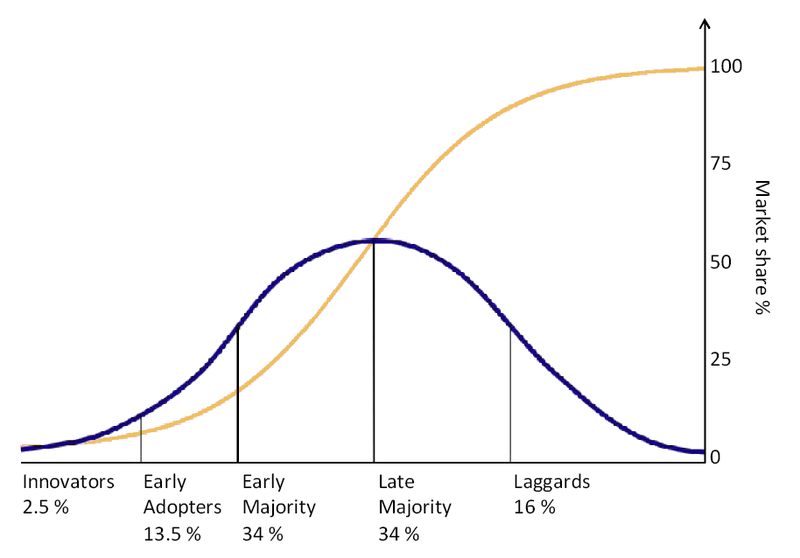
Sinek connects this to the Law of Diffusion of Innovation. The innovators and early adopters are those comfortable with an idea of why, and are willing to play with new ideas and technology even if it hasn't been refined well enough for general adoption. The challenge is, once the technology is ready the mass market, is getting acceptance with the early majority. The "what" will be foreign to them, and they don't instinctively gravitate to understanding the "why" -- you have to give them a compelling "why" so they get an ah-ha moment and become comfortable with the new product.