Obama has been out every day reminding those of us in the middle how far to the left he is from where he ran in 2008. He's firming up the wrong base.
Its amazing that the Blues don't understand that all BHO's comments, particularly the punish your enemies meme, are on FOX, talk radio and the Internet. Your trash talk goes right into the other guy's locker room.
... the "locker room" analogy is slightly misleading. It's not just that rousing the Dem base also rouses the GOP base (which can hardly be roused more than it already is anyway). It's that rousing the Dem base alienates the middle.
Were Dems always faced with that base-vs.-middle tradeoff?
On issues like immigration reform, it seems like they are now. (Welfare was a base-vs.-middle issue, of course. The middle hated welfare. But Dems could always soft-pedal and hide their cash-dispensing programs in the fine print while pretending that they were requiring work—and then relying on other issues to mobilize the base. On immigration, it seems as if the only way to rouse the Dems' Latino base, Obama-style, is to shout your support for an immigration amnesty from the rooftops, where the middle can also hear it.)
Saturday, October 30, 2010
Mikey Kaus and Multiple Audiences
Saw this bit in the Kaus Files today that shows the importance of understanding the different relationships you're in and how a message for one can impact the other:

Sunday, October 24, 2010
Start With Why
Simon Sinek's TED Presentation:
The image above shows Sinek pointing to his "Golden Circle."
Most people start from the outside -- we know what our companies make, some have an idea how we do it, few have a clear idea why. That lack of a clear "why" causes dissonance with people -- it causes them to have a bad gut reaction; the what and how may look logical but they can't put their finger on the source of their doubt.
Sinek advocates flipping that around. Start with a clear, simple "why." Tie this in to Duarte's work in Resonance -- establish a simple core contrast of what is and what could be. Then you can work on the mechanics of how it's achieved and what the final deliverables will be.

Sinek connects this to the Law of Diffusion of Innovation. The innovators and early adopters are those comfortable with an idea of why, and are willing to play with new ideas and technology even if it hasn't been refined well enough for general adoption. The challenge is, once the technology is ready the mass market, is getting acceptance with the early majority. The "what" will be foreign to them, and they don't instinctively gravitate to understanding the "why" -- you have to give them a compelling "why" so they get an ah-ha moment and become comfortable with the new product.
The image above shows Sinek pointing to his "Golden Circle."
Most people start from the outside -- we know what our companies make, some have an idea how we do it, few have a clear idea why. That lack of a clear "why" causes dissonance with people -- it causes them to have a bad gut reaction; the what and how may look logical but they can't put their finger on the source of their doubt.
Sinek advocates flipping that around. Start with a clear, simple "why." Tie this in to Duarte's work in Resonance -- establish a simple core contrast of what is and what could be. Then you can work on the mechanics of how it's achieved and what the final deliverables will be.
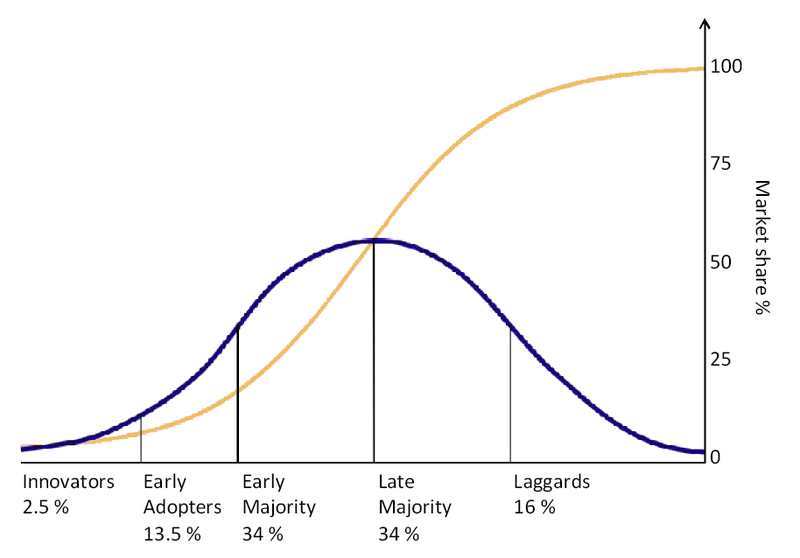
Sinek connects this to the Law of Diffusion of Innovation. The innovators and early adopters are those comfortable with an idea of why, and are willing to play with new ideas and technology even if it hasn't been refined well enough for general adoption. The challenge is, once the technology is ready the mass market, is getting acceptance with the early majority. The "what" will be foreign to them, and they don't instinctively gravitate to understanding the "why" -- you have to give them a compelling "why" so they get an ah-ha moment and become comfortable with the new product.
Saturday, October 23, 2010
A couple interesting TEDs
Daniel Pink on "The Science of Motivation"
The fundamental drive to do things is: Because they matter.
Autonomy: ability to direct our own lives.
Mastery: ability to get better
Purpose: yearning to do something bigger then ourselves.
He also mentions the "Results Only Work Environment" (ROWE) as providing 20% improvements in productivity. My immediate thought was what is the impact from the greater autonomy v. simply being a change in the environment, or even the Hawthorne Effect where people improve productivity simply because they're being studied.
Sir Ken Robinson on "Do Schools Kill Creativity?"
Interestingly while most people criticize schools for being organized to turnout out workers for the industrial economy, he criticizes them as trying to produce university professors.
The fundamental drive to do things is: Because they matter.
Autonomy: ability to direct our own lives.
Mastery: ability to get better
Purpose: yearning to do something bigger then ourselves.
He also mentions the "Results Only Work Environment" (ROWE) as providing 20% improvements in productivity. My immediate thought was what is the impact from the greater autonomy v. simply being a change in the environment, or even the Hawthorne Effect where people improve productivity simply because they're being studied.
Sir Ken Robinson on "Do Schools Kill Creativity?"
Interestingly while most people criticize schools for being organized to turnout out workers for the industrial economy, he criticizes them as trying to produce university professors.
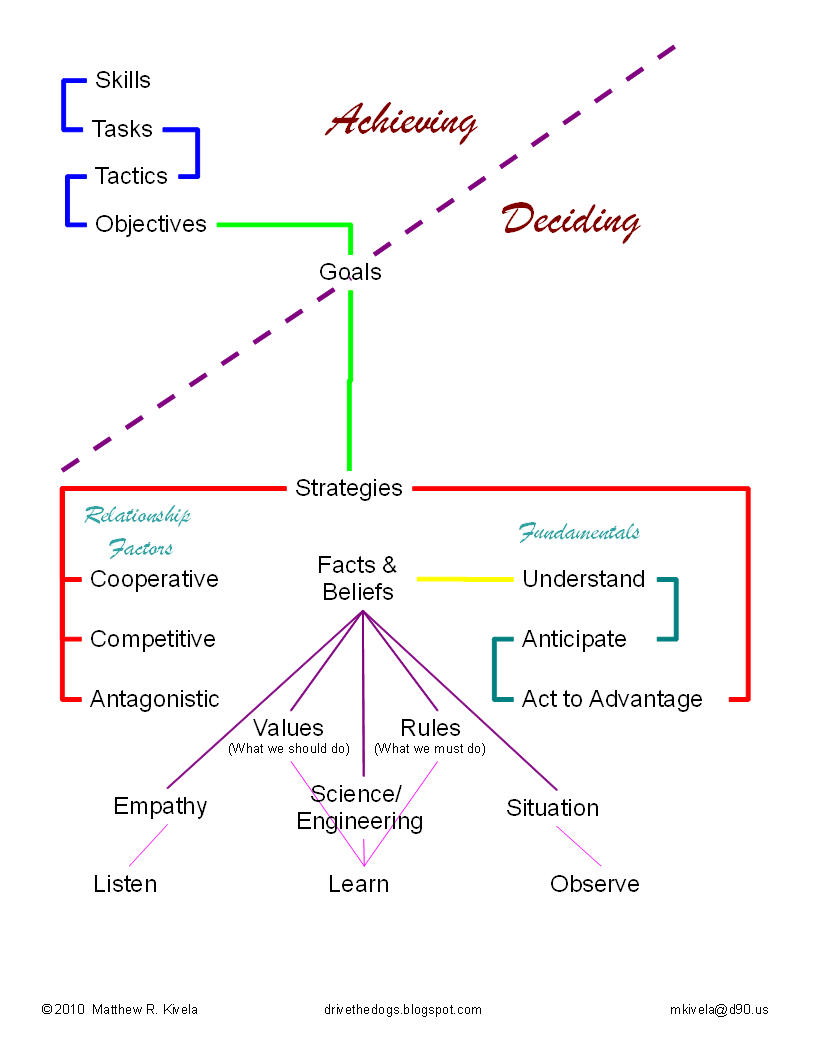
There are three fundamental concepts to developing strategy: Understand the situation, anticipate the reaction of others, and act to advantage.
Understand the situation:
In June 1815 Wellington had his British Army and the Prussian Army in Belgium, but the allies had decided to wait until July 1st when the rest of the allied armies would assemble before attacking France. The British and Prussian forces were dispersed. Wellington knew the terrain of Belgium well.
Anticipate:
If Napoleon attacked it was reasonable to anticipate his strategy would be to attack the dispersed forces, to cut off the lines of communication between the Prussians and British armies by moving quickly north to the west of Brussels, then turn westward to cut off the British from the port of Antwerp.
Act to Advantage:
Wellington kept his forces dispersed. Napoleon struck, once he engaged the Prussian Army Wellington could anticipate the logical route he would continue on and began concentrating at Waterloo.
Waterloo had special terrain -- the main battlefield had gently rolling hills that allowed much of the British Army to concentrate their unseen behind those hills. Strong holds -- one a small village, one a woods could secure either flank by being fortified while still concealing the strength of forces. Here, Wellington could hope, Napoleon would not realize that the dispersed British Army had been concentrated until after he was committed to the attack.
Wellington understood the situation and terrain, he anticipated Napoleon's choices, and acted to take advantage decisively. So well thought out and executed, we still speak of a crushing defeat as to have "met one's Waterloo."
Tuesday, October 19, 2010
Resonate
I'm currently reading Nancy Duarte's book Resonate.
While nominally about preparing presentations, it has a fundamental lesson about leadership:
Contrast what is with what could be.
While nominally about preparing presentations, it has a fundamental lesson about leadership:
Contrast what is with what could be.
Monday, October 18, 2010
Face Palm
I'm reminded of the phrase of a friend who, when we saw someone out wearing an amazingly bad outfit -- not a poor or lazy outfit but one the wearer spent time unintentionally creating something awful, would snark, "What kind of friends let you go out in public dressed like that?"
What kind of advisers let you say this:
Obama may not be able to express the sincerity to pull off a classic line like:
But he certainly can deliver more substantial and effective remarks like this:
Or:
It's an unfortunate refrain of the Obama Administration that no administration has faced such a difficult task as his, and perhaps even no man is capable of a great Presidency under today's circumstances. Lincoln's Second Inaugural Address seems to describe a time far worse:
An authentic voice is necessary, understanding pyschology is necessary, but condescending the people you're trying to win the support of is not, nor is using a speech to teach background material. Speeches are not lectures, organizers and websites can explain the pyschology as they teach party activists the skills of how to address the concerns of their neighbors. Obama should not be looking towards H. Ross Perot for lessons in giving speeches -- people want inspiration and a simple story, not expository material explaining facts. Multi-media presentations could have a role in politics -- but only with teams as brilliant as those who prepared Steve Job's recent keynotes. You'll note Jobs didn't explain how the iPhone's screen worked -- he just showed what it could do.
What kind of advisers let you say this:
"People out there are still hurting very badly, and they are still scared. And so part of the reason that our politics seems so tough right now, and facts and science and argument does not seem to be winning the day all the time, is because we're hard-wired not to always think clearly when we're scared," Obama said at a Democratic fundraiser Saturday in Boston. "And the country is scared, and they have good reason to be."Barrack Obama, October 16, 2010 stump speech.
Obama may not be able to express the sincerity to pull off a classic line like:
I feel your pain.Bill Clinton, Response to AIDS activist Bob Rafsky at the Laura Belle nightclub in Manhattan (March 27, 1992)
But he certainly can deliver more substantial and effective remarks like this:
So, first of all, let me assert my firm belief that the only thing we have to fear is fear itself—nameless, unreasoning, unjustified terror which paralyzes needed efforts to convert retreat into advance. In every dark hour of our national life a leadership of frankness and vigor has met with that understanding and support of the people themselves which is essential to victory. I am convinced that you will again give that support to leadership in these critical days.Franklin Roosevelt's First Inaugural Address
In such a spirit on my part and on yours we face our common difficulties. They concern, thank God, only material things. Values have shrunken to fantastic levels; taxes have risen; our ability to pay has fallen; government of all kinds is faced by serious curtailment of income; the means of exchange are frozen in the currents of trade; the withered leaves of industrial enterprise lie on every side; farmers find no markets for their produce; the savings of many years in thousands of families are gone.
More important, a host of unemployed citizens face the grim problem of existence, and an equally great number toil with little return. Only a foolish optimist can deny the dark realities of the moment.
Yet our distress comes from no failure of substance. We are stricken by no plague of locusts. Compared with the perils which our forefathers conquered because they believed and were not afraid, we have still much to be thankful for. Nature still offers her bounty and human efforts have multiplied it. Plenty is at our doorstep, but a generous use of it languishes in the very sight of the supply. Primarily this is because the rulers of the exchange of mankind’s goods have failed, through their own stubbornness and their own incompetence, have admitted their failure, and abdicated. Practices of the unscrupulous money changers stand indicted in the court of public opinion, rejected by the hearts and minds of men.
Or:
The path we have chosen for the present is full of hazards, as all paths are; but it is the one most consistent with our character and courage as a nation and our commitments around the world. The cost of freedom is always high, but Americans have always paid it. And one path we shall never choose, and that is the path of surrender or submission.JFK's Cuban Missile Crisis Address
Our goal is not the victory of might, but the vindication of right; not peace at the expense of freedom, but both peace and freedom, here in this hemisphere, and, we hope, around the world. God willing, that goal will be achieved.
It's an unfortunate refrain of the Obama Administration that no administration has faced such a difficult task as his, and perhaps even no man is capable of a great Presidency under today's circumstances. Lincoln's Second Inaugural Address seems to describe a time far worse:
On the occasion corresponding to this four years ago all thoughts were anxiously directed to an impending civil war. All dreaded it, all sought to avert it. While the inaugural address was being delivered from this place, devoted altogether to saving the Union without war, urgent agents were in the city seeking to destroy it without war—seeking to dissolve the Union and divide effects by negotiation. Both parties deprecated war, but one of them would make war rather than let the nation survive, and the other would accept war rather than let it perish, and the war came.
...
With malice toward none, with charity for all, with firmness in the right as God gives us to see the right, let us strive on to finish the work we are in, to bind up the nation's wounds, to care for him who shall have borne the battle and for his widow and his orphan, to do all which may achieve and cherish a just and lasting peace among ourselves and with all nations.
An authentic voice is necessary, understanding pyschology is necessary, but condescending the people you're trying to win the support of is not, nor is using a speech to teach background material. Speeches are not lectures, organizers and websites can explain the pyschology as they teach party activists the skills of how to address the concerns of their neighbors. Obama should not be looking towards H. Ross Perot for lessons in giving speeches -- people want inspiration and a simple story, not expository material explaining facts. Multi-media presentations could have a role in politics -- but only with teams as brilliant as those who prepared Steve Job's recent keynotes. You'll note Jobs didn't explain how the iPhone's screen worked -- he just showed what it could do.
Sunday, October 17, 2010
Empathy
From this article on youth and empathy from the Boston Globe:
But at the most basic level, most concur that empathy is some sort of emotional response to another person’s plight, pain, state, or suffering. “It’s not just putting oneself in another’s shoes,” said Aaron L. Pincus, a professor of psychology at Penn State University. “It’s truly grasping what they’re experiencing....Your emotional state will move in a direction more similar to the person you’re empathizing with.”
Subscribe to:
Posts (Atom)